
To communicate confidently in English, you need to know the most frequently asked questions in real-life situations.
Whether you're traveling, starting a new job, or meeting new people, these questions will help you keep conversations flowing naturally.
Below, you'll find 54 essential questions in English you can start using right away.
Here we'll look at the main ones you should know well.
There are certainly many more questions, but this list will be the perfect guide to help you navigate common situations.
Learn how to ask questions naturally in English
At Papora, you practice real-life conversations in unlimited live classes. Speak from day one and build confidence step by step with expert native-level teachers.
Start speaking today


54 Frequently Asked Questions in English You Should Learn
Learning to ask, develop, and answer questions in English helps you communicate information much more effectively. Furthermore, after learning it, you can develop phrases that aren't necessarily part of a specific question or answer.
12 questions in English to introduce yourself or say hello
| 1 | What's your name? |
| 2 | How are you doing? / How do you do? |
| 3 | How old are you? |
| 4 | Are you married? |
| 5 | Where were you born? |
| 6 | Where are you from? |
| 7 | Are you from this area? |
| 8 | So, what do you do for a living? |
| 9 | Have we met before? |
| 10 | Do you like football? Our local team is playing this evening… |
| 11 | Where do you live? |
| 12 | What are you doing? |
Frequently asked questions in English for everyday situations
| 13 | Could you tell me where the bathroom is, please? |
| 14 | Do you know what time it is? |
| 15 | Would you like something to drink? |
| 16 | Is this seat taken? |
| 17 | Do you know what time this place closes? |
| 18 | Can I ask where you got it? |
| 19 | Do they have other colors available? |
| 20 | Do you come here a lot? |
| 21 | Can I have the bill please? |
| 22 | Can you give me an example? |
| 23 | Do you have a girlfriend/boyfriend? |
| 24 | Do you know how to get to the Marriott Hotel? |
| 25 | Do you need anything else? |
| 26 | Is anyone else coming? |
| 27 | Which one is cheaper? |

Frequently asked questions in English for the workplace
| 28 | With whom are you working? |
| 29 | Why do you want to work for us? |
| 30 | Where do you see yourself in five years? |
| 31 | What can you do for us that someone else can´t? |
| 32 | What do you find most attractive about this position? |
| 33 | What do you look for in this job? |
| 34 | What motivates you? |
| 35 | What do you think of your boss? |
| 36 | What is the performance review process like? |
| 37 | What kind of employee training do you provide? |
| 38 | Sorry, but could you outline the main points again? |
| 39 | How was your weekend? |
| 40 | Anything new going on? |
| 41 | May I ask you where are you staying? |
| 42 | How was your trip, did you have any problem finding the office? |
| 43 | Would you like joining us for lunch? |
| 44 | Are you ready? |
| 45 | How are things? |
| 46 | What do you think about…? |
| 47 | What would you like to eat? |
| 48 | Who said that? |
| 49 | What’s new? |
| 50 | Where is my…? |
| 51 | Have you got a car / job / house / etc.? |
| 52 | Would you please say that again? |
| 53 | When do you get off work? |
| 54 | Are you waiting for someone? |
Practice these questions in real conversations
Reading them is the first step. At Papora, you practice English in unlimited live classes and build confidence through real communication. You also get access to 500+ interactive lessons and levels up to C1.
Start practicing now
Expert tips from Papora for learning common English questions
Learning common English questions becomes much easier when you practice consistently and focus on real communication.
Here are simple tips to help you remember and use them naturally in everyday conversations.
Use flashcards or study cards
Flashcards are a practical way to memorize essential English questions.
Include the question in English and its translation. Review them daily and say them out loud to build confidence.
“Flashcards are a very effective tool for memorizing vocabulary, especially at lower levels. I like using Quizlet because you can add images and students can access the flashcards anytime they want to practice.”

Use question tags
Question tags are short questions added at the end of a sentence.
They help you sound more natural and make conversations flow more easily.
“A question tag is added to the end of a sentence to turn it into a question. It uses the same auxiliary verb as the statement, followed by a pronoun. For example: “Can you?”, “Isn’t it?”, or “Couldn’t you?””

Learn how to use auxiliary verbs
Auxiliary verbs like do, does, and did are essential for forming questions in English.
Once you understand how they work, asking questions becomes much more natural.
Want to practice questions with “do” and “does”? Check our full guide here.
“One of the biggest challenges in English grammar is knowing how and when to use auxiliary verbs. They are essential for forming questions and expressing time correctly. It takes practice to use them naturally.”

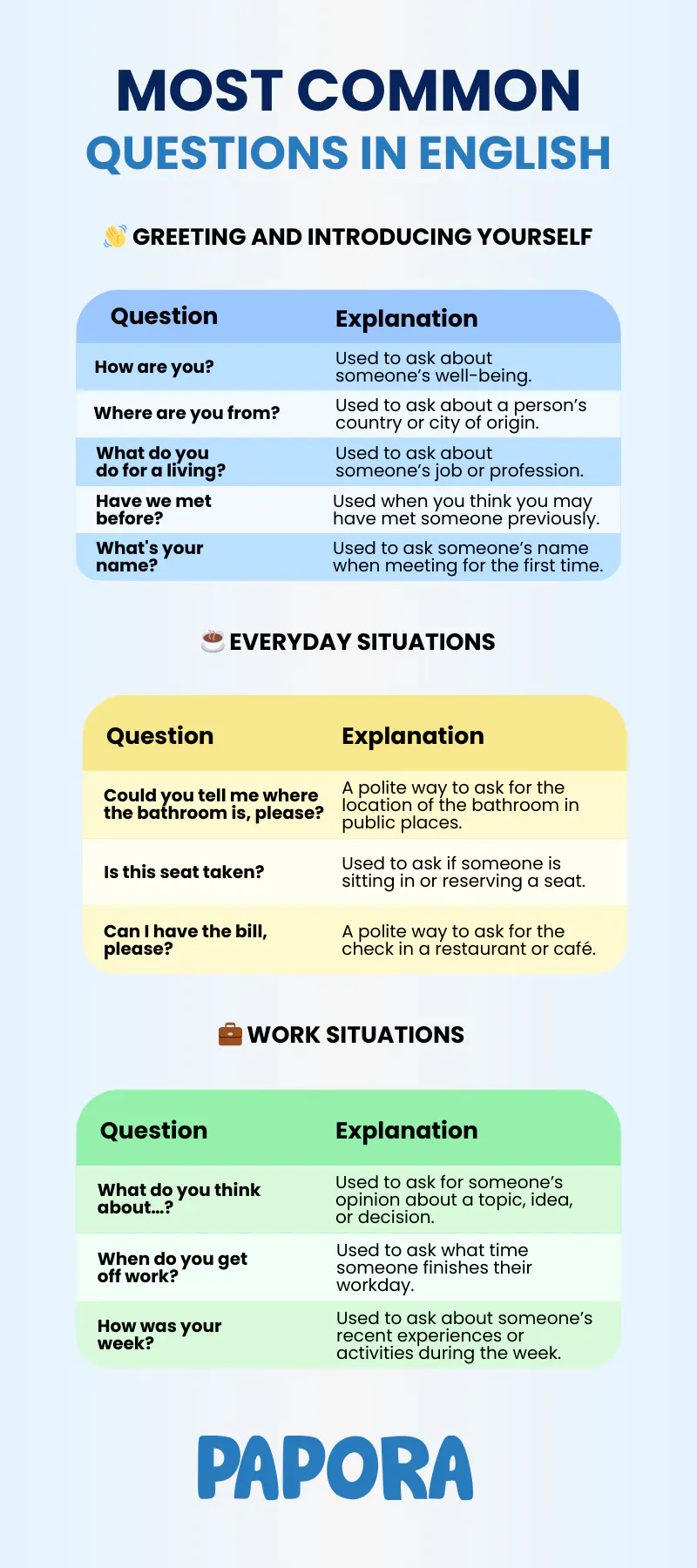
Infographic: Most Common Questions in English
Below, you can see a visual summary of some of the most frequently asked questions in English for real-life situations.
These questions are grouped into three key areas:
- Greeting and introducing yourself
- Everyday situations
- Work situations
Use this infographic as a quick reference when you need to remember how to ask something naturally.
If you can recognize these questions and understand when to use them, you’re already building a strong foundation for real communication in English.
Learn English with Papora
Learning common English questions is just the beginning. To use them naturally, you need real practice in real conversations.
With Papora, you get:
- Unlimited live classes in small groups
- 500+ interactive lessons available 24/7
- Levels from A1 to C1
- Expert native-level teachers focused on real communication
You don’t study isolated phrases. You learn how to use them confidently in everyday situations.
Start using English questions with confidence
In Papora’s unlimited live classes, you speak from day one and receive guidance from expert native-level teachers.
You also get access to 500+ interactive lessons and levels up to C1 to keep improving at your own pace.
Frequently asked questions about essential questions in English
The grammatical structure of a question in English is highly variable and depends primarily on its purpose. However, the most basic formula would be: "Wh question + main verb (usually the verb 'to be') + complement + ?". Although, once again, this varies depending on the wording and intention of the question.
The structure of a question in this language always depends on its purpose. There are four types of structures: Yes/No questions, wh-questions, question tags, and choice questions. You will learn this grammar in depth in Papora's live classes.
At Papora you can learn to ask questions in English and much more, with a dynamic methodology and content inspired by everyday situations, you will be able to understand from the first day and advance faster and faster.