
If you're learning English, one of the first grammar points you need to understand is how to use do and does.
These forms come from the verb “to do” and are used differently depending on the subject and the tense.
In the present simple, the rule is clear: we use do with I, you, we, and they, and does with he, she, and it.
What do and does mean?
Do and does come from the infinitive to do. Normally, the verb to do, as the main verb, means to do or make.
Look at these examples:
- I do yoga twice a week.
- Mary makes dinner and John does the washing up.
- The children do their homework in the evenings.
In all these sentences, the verb "to do" means "to do" and is used to describe activities that are done.
Understanding the structure is one thing - using it confidently is another. Let’s put it into practice.
Practice How to Use Do and Does in Real Conversations
At Papora, you don’t just learn grammar rules. You practice them in real situations with expert teachers and 500+ interactive lessons, from A1 to C1.
Start practicing now


“Many learners confuse “do” and “make.” A simple rule is this: we use do for actions and activities that don’t create a physical result. Understanding this makes it easier to use do and does correctly in sentences.”

In this sense, the grammatical structure of a sentence with Do/does as the main verb is as follows:
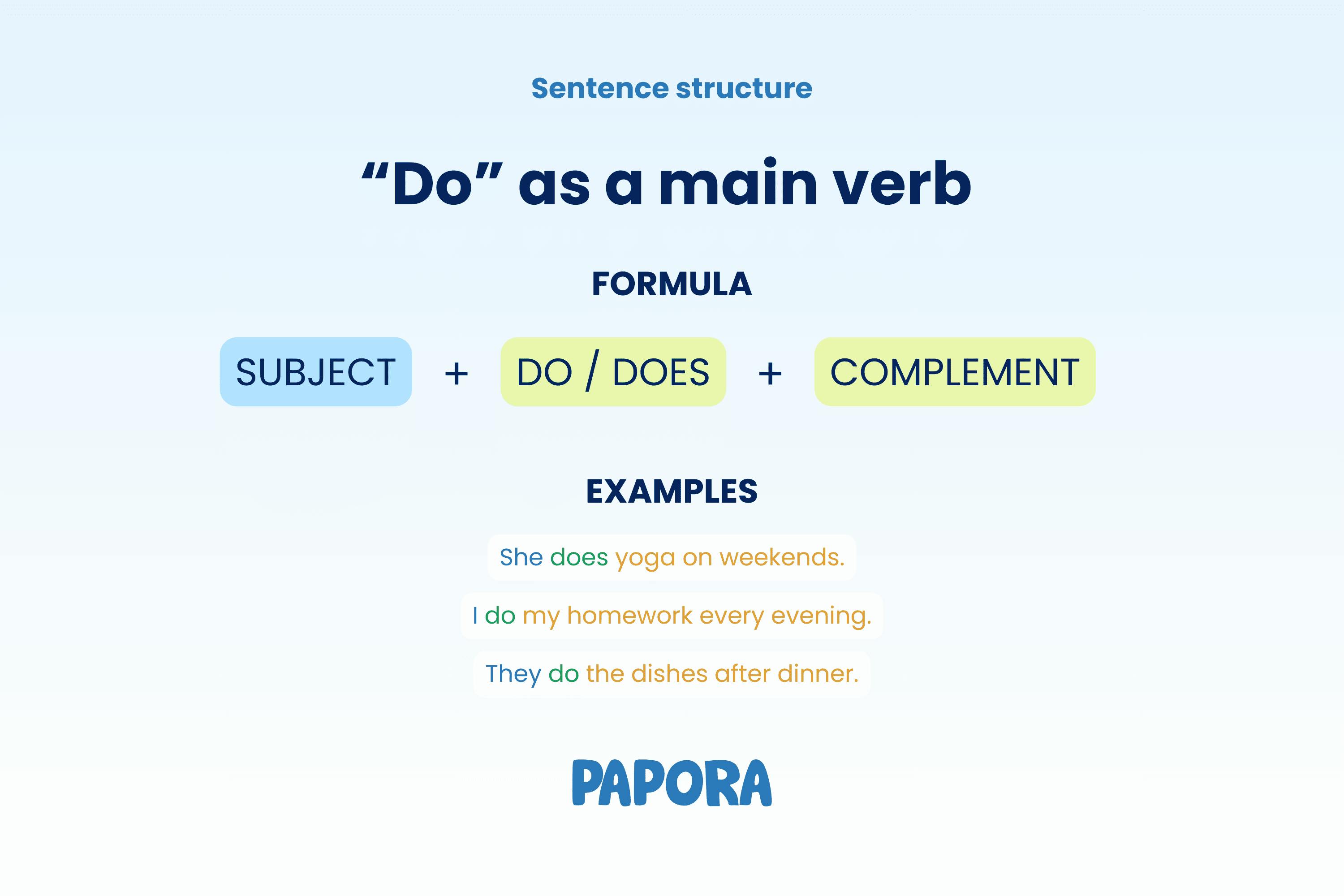
You may have noticed that in the second example we used "does" instead of "do." We say "John does" and not "John do" because we used the third person singular. However, we say "I do yoga" because we used the first person singular. To summarize:
- I do the washing up.
- You do the washing up.
- He/She does the washing up.
- We do the washing up.
- You do the washing up.
- They do the washing up.
In the present simple tense in English, there is a change in the verb conjugation in the third person singular. In the case of the verb "to do," "do" becomes "does." I do. But He (She/It) does.
“Do/does are auxiliary verbs that help create negative and interrogative sentences in the simple present tense. I usually tell my students that if there is a "does" in the sentence, it is not necessary to add the "s" for the third person, since DOES does the job.”

Forms and uses of the verb do as an auxiliary
This verb is one of the auxiliary verbs with the most uses and variations you'll find in the language, and it's often one of the most confusing concepts for students.
The verb "to do" functions as an auxiliary verb in both the simple present and the simple past tenses, when the sentence is negative or interrogative.
In examples where the verb "to do" is used as an auxiliary verb, "do," "does," and "did" don't have any meaning. Rather, they act as support for the sentence. They essentially hold the sentence together.
They don't add content, but rather structure.
Do as negative sentences
In negative sentences, "do not" / "does not" allows us to negate the simple present tense, and is used precisely to negate the action of the main verb in the sentence.
The grammatical structure of this form is as follows:
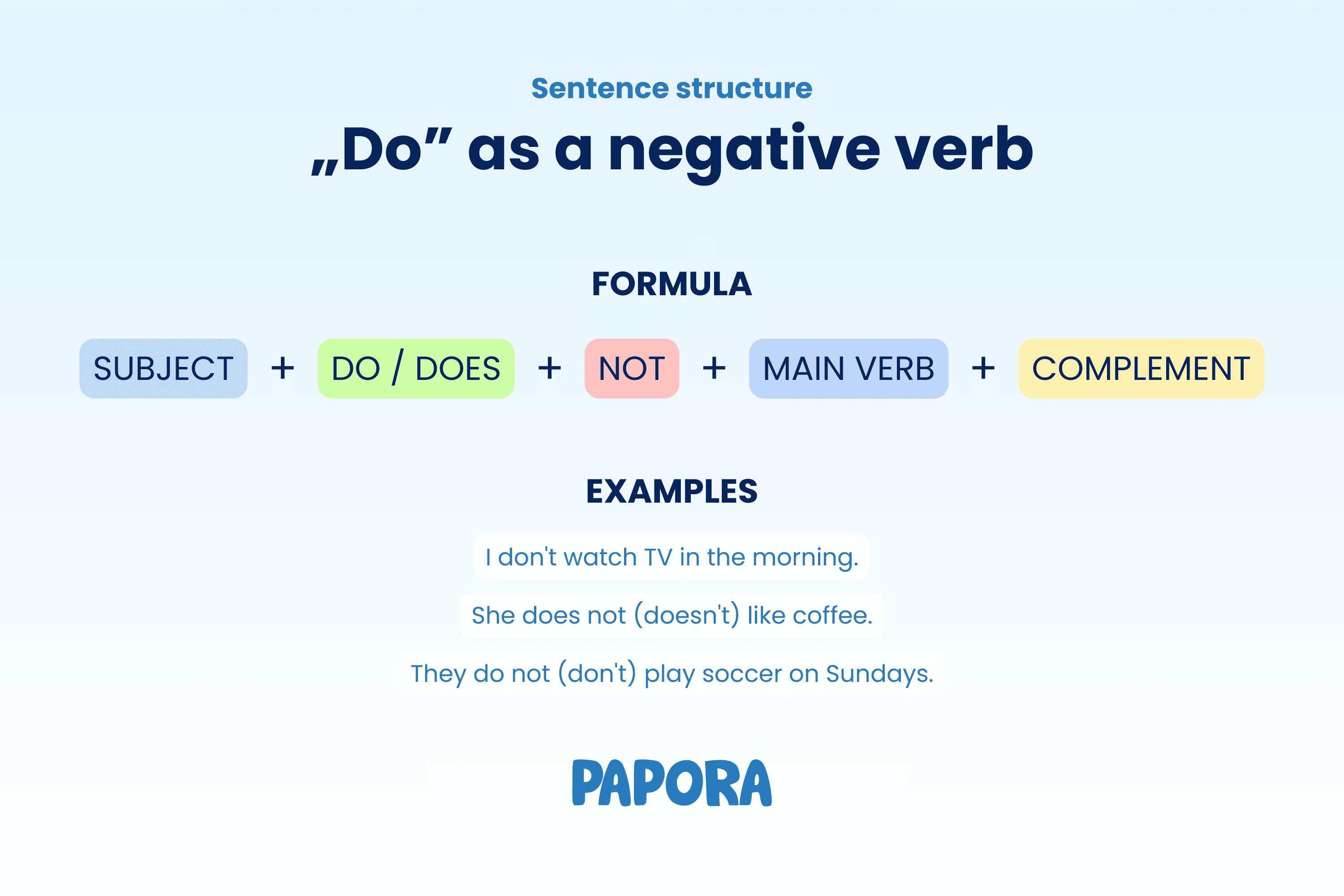
For example:
- He does not like to eat cookies
- I do not watch YouTube
- The baby does not like pumpkin
As an interrogative auxiliary verb
It also works for asking questions; it's used implicitly, meaning it doesn't have a specific meaning.
The verb "do" is used within a question when the main verb is not "to be."
It can be used in conjunction with WH questions or on its own; however, when used in conjunction, it must come first with Wh + Do + Subject.
In this case, the grammar is:
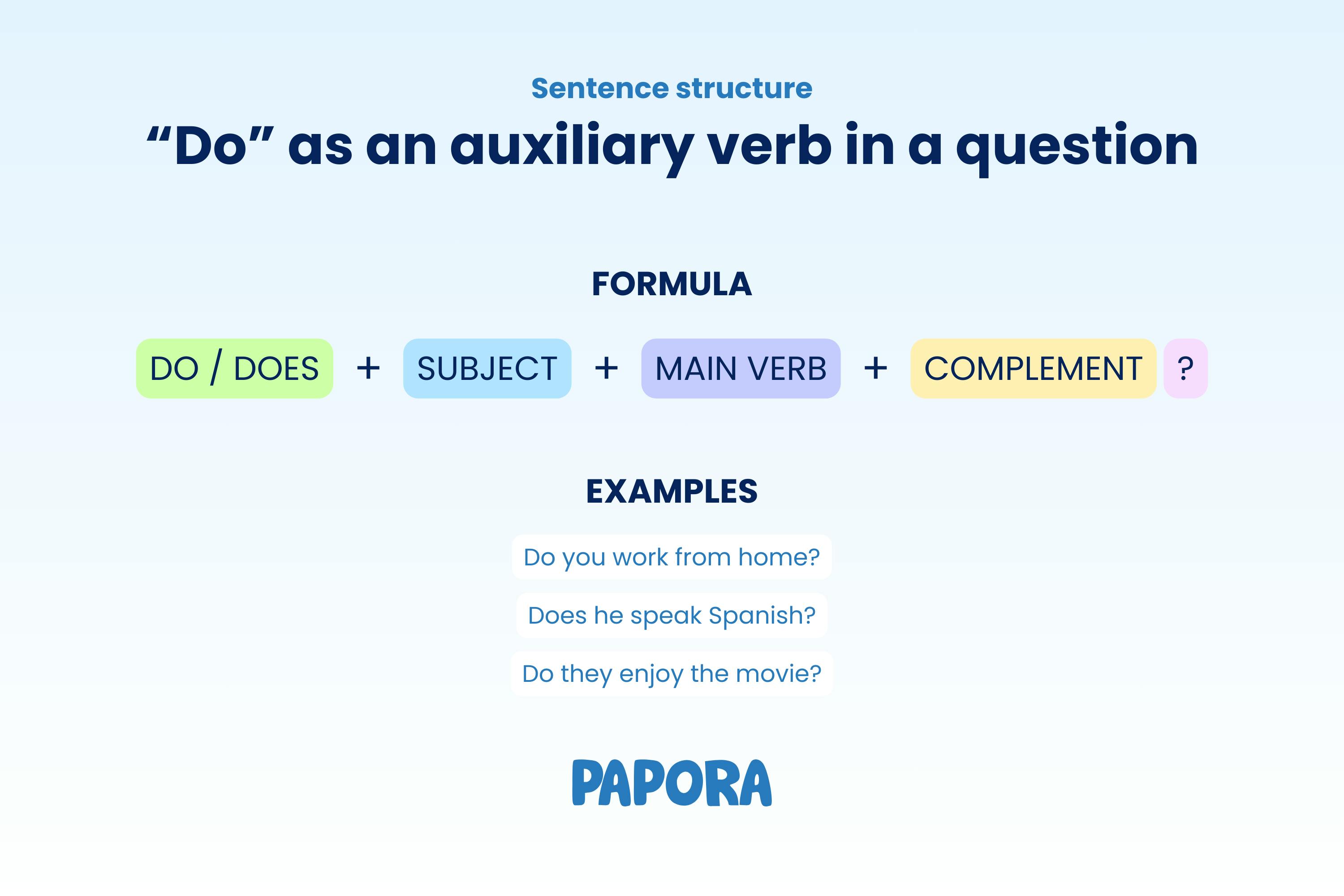
For example:
- Does he speak english?
- Do you play baseball?
- What do you do in your free time?
This last sentence translates as "What do you do in your free time?", and in it we see the two uses of "do" in a question.
In the first part of the sentence, "do" is being used as an auxiliary verb with a Wh question to ask the question: What do you do in your free time?
In the second part of the sentence, it is used as the main verb, meaning "to do" or "to make": What do you do in your free time?
Master How to Use Do and Does - and Much More
Understanding the rules is the first step. At Papora, you practice it in real conversations with expert teachers and over 500 interactive lessons, from A1 to C1.
Start learning today
As the simple past tense of Do
In the simple past tense, do and does become simply "Did," and this auxiliary verb has the same function as the other two, only in this case, it expresses past tense. When using did, it remains the same regardless of the pronoun used in the sentence.
The main verb would be:
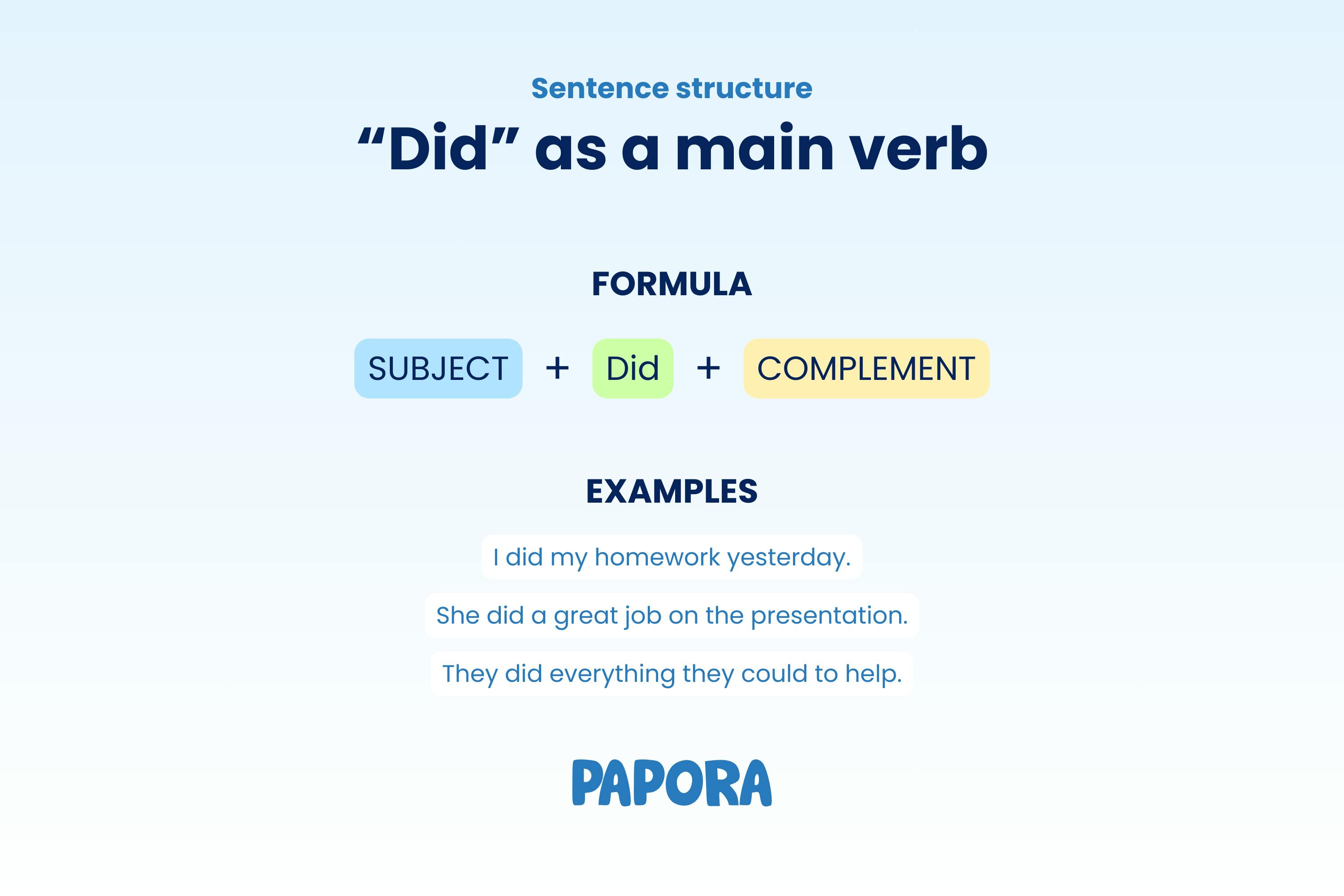
For example:
- I did my homework yesterday.
- You did exercises.
- They did a great job.
In negative sentences
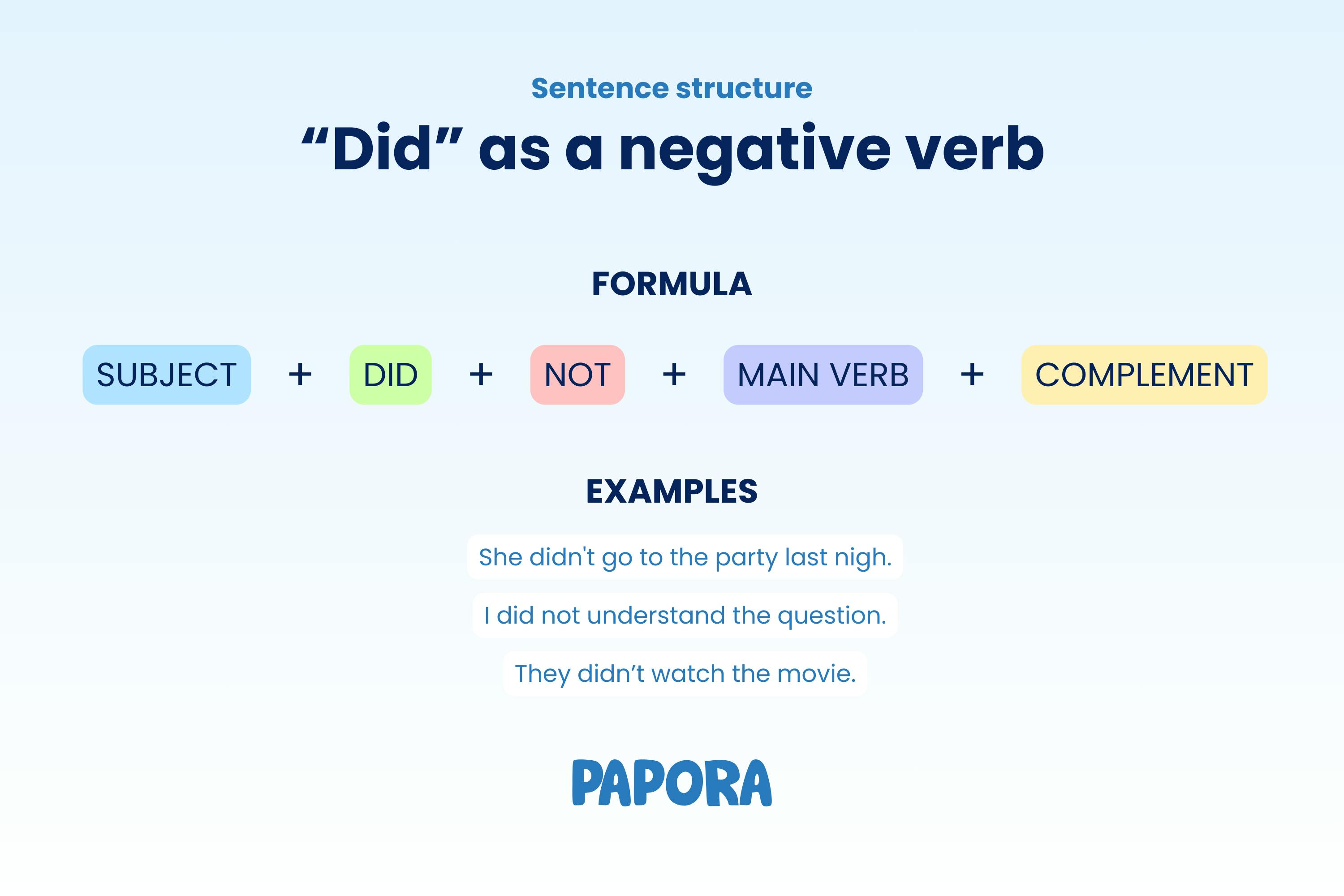
For example:
- He did not like fish
- She did not go to last night's concert
- They did not play tennis.
As an auxilliary interrogative
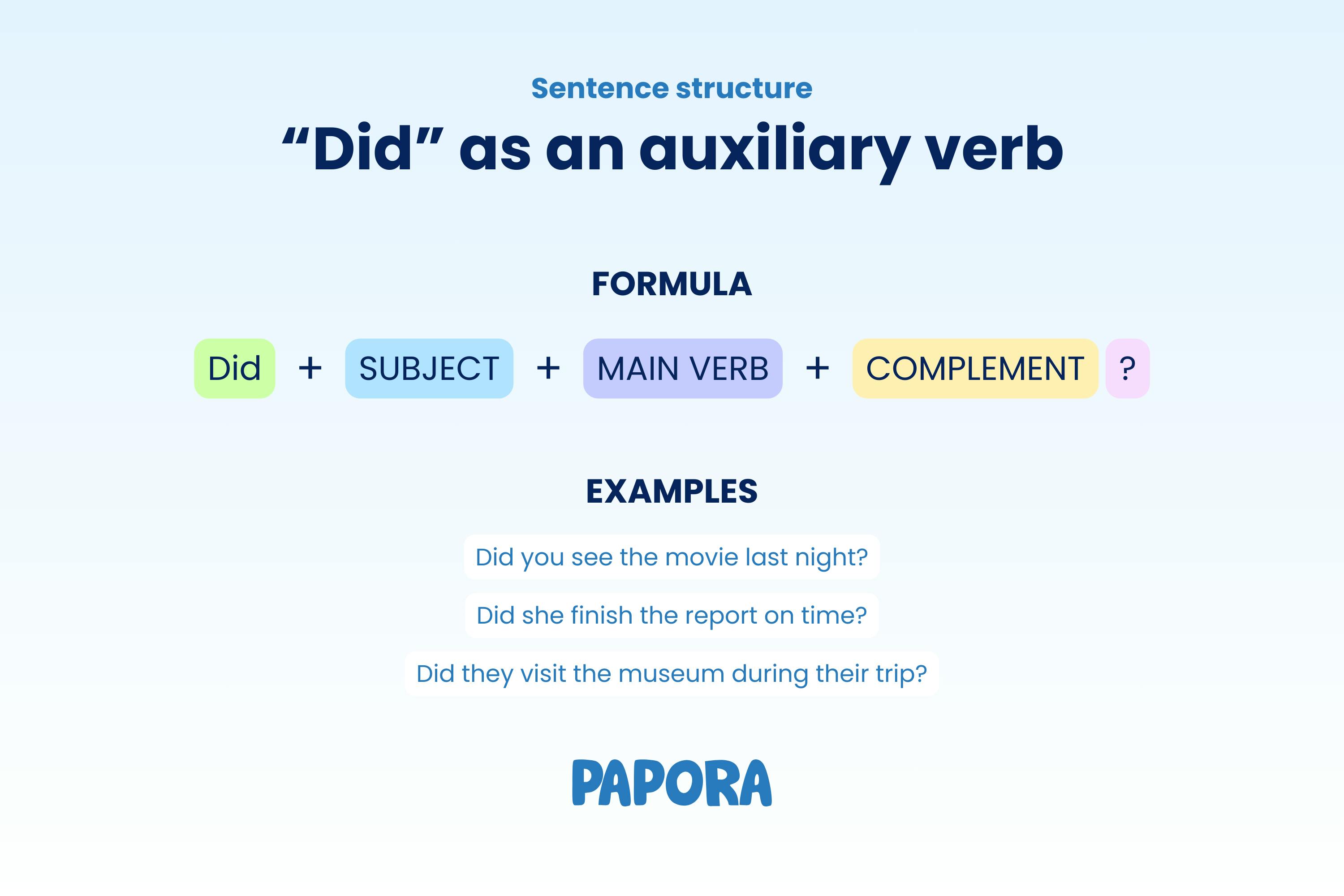
- Did they play basketball?
- Did he like eggs when he was a child?
- When did you do your homework?
How to use Do and Does for short answers?
The auxiliary verb can be used in English to give a short answer to a question.
For example, if someone asks you:
- Do you drink coffee?
You can answer:
- Yes, I do.
There's no need to repeat the entire sentence "Yes, I drink coffee." With the auxiliary verb, it's already understood. That's what I call a linguistic shortcut!
Let's see how the short answer with the auxiliary verb "to do" works in the simple present tense:
- Do you speak Italian? Yes, I do. / No, I don’t.
- Does he speak French? Yes, he does. / No, he doesn’t.
- Does she speak German? Yes, she does. / No, she doesn’t.
- Do you speak Spanish? Yes, we do. / No, we don’t.
- Do they speak Chinese? Yes, they do. / No, they don’t.
…and in the simple past tense:
- Did you go to England? Yes, I did. / No, I didn’t.
- Did he go to Holland? Yes, he did. / No, he didn’t.
- Did she go to Canada? Yes, she did. / No, she didn’t.
- Did you go to Argentina? Yes, we did. / No, we didn’t.
- Did they go to Australia? Yes, they did. / No, they didn’t.
While following guides like these is very helpful, remember that the most important thing will always be consistent practice, and thanks to everything the internet offers, you can study using technology.
You can log into courses like Papora, where you learn with fun content and understand how all aspects of the language are used almost without realizing it.
You can go to YouTube and identify where do/does/did are used in music or learn new vocabulary.
“If you are a music lover, discovering English through music can be your most effective way to learn.”

One important topic for asking questions or forming sentences with the verbs "do" and "does" is possessive adjectives in English. But the most important thing is always to have fun and never stop learning!
Practice Do and Does with Real English from A1 to C1
You now understand how to use do and does. The next step is using them confidently in real conversations. With 500+ interactive lessons and unlimited live classes, Papora helps you move from rules to real communication.
Start learning with Papora
Frequently asked questions about do and does in English
When it comes to Do/Does as the main verb of the sentence, the meaning of the word is directly "to do," not "to create," as in the case of make, but to do; when it comes to the auxiliary verb, it does not have a meaning as such, that is, it does not add content, it only works to give context.
We use do and does as auxiliary verbs when the main verb is not “to be.” They come before the subject in questions, like Do you speak English?
With regular speaking practice, these structures become natural - that’s exactly how you work with them at Papora.