
You’ll often need to talk about professions in English - whether at work, while traveling, or during a job interview.
Knowing the names of common jobs helps you introduce yourself and understand what others do.
If you want to practice this vocabulary in real conversations, it helps to learn with the right tools.
Build confidence talking about jobs in English
Learning professions in English is a great start. With Papora, you practice speaking about jobs and everyday topics in live classes with expert native-level teachers.
Practice speaking about jobs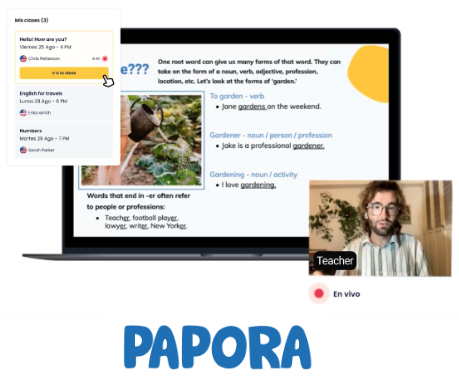


Vocabulary related to professions
Before learning different job titles, it helps to understand some basic work-related words.
These terms will make it easier to talk about jobs, workplaces, and careers in everyday conversations.

First, review this initial vocabulary list:
| ENGLISH | MEANING |
| career | A long-term professional path or series of jobs in a particular field. |
| contract | A formal agreement between two or more people or organizations. |
| day off | A day when you do not have to work. |
| employee | A person who works for a company or organization. |
| boss | The person who is in charge of workers or a company. |
| job | Work that a person does to earn money. |
| occupation | A person’s regular job or profession. |
| profession | A job that requires special education or training. |
| raise | An increase in the amount of money you earn at work. |
| schedule | A plan that shows the times when tasks or activities happen. |
| work | Activities you do to complete tasks or earn money. |
101 English professions you should know
Here are 101 professions in English that will help you talk about jobs, careers, and work in everyday conversations.
Later in the article, you’ll also find audio recordings to help you learn the correct pronunciation.
| # | English | Meaning |
| 1 | Accountant | A person who manages financial records and taxes. |
| 2 | Actor | A person who performs in movies, theater, or television. |
| 3 | Actress | A woman who performs in movies, theater, or television. |
| 4 | Archaeologist | A scientist who studies ancient cultures and historical remains. |
| 5 | Architect | A person who designs buildings. |
| 6 | Astrologer | A person who studies the influence of stars and planets. |
| 7 | Astronaut | A person trained to travel into space. |
| 8 | Athlete | A person who practices sports professionally. |
| 9 | Baker | A person who makes bread and cakes. |
| 10 | Biologist | A scientist who studies living organisms. |
| 11 | Bricklayer | A worker who builds with bricks. |
| 12 | Bus driver | A person who drives a bus. |
| 13 | Businessman | A man who works in business. |
| 14 | Businesswoman | A woman who works in business. |
| 15 | Butcher | A person who prepares and sells meat. |
| 16 | Caretaker | A person who takes care of a building or property. |
| 17 | Carpenter | A person who builds or repairs wooden objects. |
| 18 | Cashier | A person who receives payments in a store. |
| 19 | Cleaner | A person who cleans homes or buildings. |
| 20 | Clown | A performer who entertains people with humor. |
| 21 | Coach | A person who trains athletes or teams. |
| 22 | Cobbler | A person who repairs shoes. |
| 23 | Consultant | A person who gives professional advice. |
| 24 | Cook | A person who prepares food. |
| 25 | Counselor | A person who provides advice or guidance. |
| 26 | Chef | A professional cook in a restaurant. |
| 27 | Chemist | A scientist or pharmacist who works with chemicals or medicines. |
| 28 | Comedian | A person who entertains people by telling jokes. |
| 29 | Dancer | A person who performs dance professionally. |
| 30 | Decorator | A person who decorates rooms or interiors. |
| 31 | Dentist | A doctor who treats teeth. |
| 32 | Director | A person who leads a company or directs a film. |
| 33 | Designer | A person who creates designs for products or graphics. |
| 34 | Doctor | A medical professional who treats illnesses. |
| 35 | Dressmaker | A person who makes clothes or dresses. |
| 36 | Driver | A person who drives a vehicle professionally. |
| 37 | Dustman | A worker who collects garbage. |
| 38 | Economist | A person who studies or works with economics. |
| 39 | Electrician | A person who installs and repairs electrical systems. |
| 40 | Engineer | A person who designs and builds machines or systems. |
| 41 | Farmer | A person who grows crops or raises animals. |
| 42 | Fireman | A person who puts out fires and rescues people. |
| 43 | Fisherman | A person who catches fish. |
| 44 | Florist | A person who sells flowers. |
| 45 | Fruiterer | A person who sells fruit. |
| 46 | Gardener | A person who takes care of plants and gardens. |
| 47 | Hairdresser | A person who cuts and styles hair. |
| 48 | Housewife | A person who manages household duties. |
| 49 | Hunter | A person who hunts animals. |
| 50 | Jeweller | A person who makes or sells jewelry. |
| 51 | Journalist | A person who writes or reports news. |
| 52 | Judge | A person who decides cases in court. |
| 53 | Lawyer | A person who gives legal advice or represents people in court. |
| 54 | Librarian | A person who manages a library. |
| 55 | Lifeguard | A person who protects swimmers at pools or beaches. |
| 56 | Magician | A performer who entertains people with magic tricks. |
| 57 | Mailman | A person who delivers letters and packages. |
| 58 | Mechanic | A person who repairs machines or vehicles. |
| 59 | Meteorologist | A scientist who studies the weather. |
| 60 | Miner | A person who works in mines extracting minerals. |
| 61 | Model | A person who displays clothes or products for photos or fashion shows. |
| 62 | Monk | A man who lives in a religious community. |
| 63 | Musician | A person who plays music professionally. |
| 64 | Nanny | A person who takes care of children in a home. |
| 65 | Nun | A woman who lives in a religious community. |
| 66 | Nurse | A medical professional who cares for patients. |
| 67 | Nursemaid | A person who takes care of children. |
| 68 | Painter | A person who paints houses, walls, or pictures. |
| 69 | Pharmacist | A person who prepares and sells medicine. |
| 70 | Photographer | A person who takes photographs professionally. |
| 71 | Philosopher | A person who studies ideas about life and knowledge. |
| 72 | Physicist | A scientist who studies matter and energy. |
| 73 | Pilot | A person who flies an airplane. |
| 74 | Plumber | A person who installs and repairs water pipes. |
| 75 | Policeman | A man whose job is to enforce the law and protect people. |
| 76 | Politician | A person involved in government and politics. |
| 77 | Porter | A worker who carries luggage or helps maintain buildings. |
| 78 | Postman | A person who delivers letters and packages. |
| 79 | President | The leader of a country or organization. |
| 80 | Priest | A religious leader in some Christian churches. |
| 81 | Professor | A senior teacher at a university. |
| 82 | Programmer | A person who writes computer software. |
| 83 | Psychiatrist | A doctor who treats mental health conditions. |
| 84 | Psychologist | A specialist who studies the human mind and behavior. |
| 85 | Receptionist | A person who greets visitors and answers phone calls. |
| 86 | Researcher | A person who studies a subject to discover new information. |
| 87 | Sailor | A person who works on ships or boats. |
| 88 | Salesman | A man who sells products or services. |
| 89 | Scientist | A person who studies science professionally. |
| 90 | Secretary | A person who assists with administrative tasks. |
| 91 | Shoemaker | A person who makes or repairs shoes. |
| 92 | Singer | A person who performs songs. |
| 93 | Sportsman | A person who practices sports professionally. |
| 94 | Stewardess | A woman who assists passengers on an airplane. |
| 95 | Surgeon | A doctor who performs operations. |
| 96 | Teacher | A person who teaches students. |
| 97 | Vet | A doctor who treats animals. |
| 98 | Veterinarian | A medical professional who cares for animals. |
| 99 | Waiter | A man who serves food and drinks in a restaurant. |
| 100 | Waitress | A woman who serves food and drinks in a restaurant. |
| 101 | Writer | A person who writes books, articles, or stories. |
You've probably heard some of the words on this list, like "teacher." However, you might not have known "stewardess" or "dustman."
Boost your English by memorizing the 5 or 10 professions you find most challenging. You'll be able to sound like an expert in any conversation!

Typical work-related expressions in English
Remember that to expand your vocabulary and become more fluent, you should know a list of regular and irregular verbs.
Here are some common phrases that will help you:
- What do you do?
- What kind of work you do?
- Where do you work?
- I’m very interested in your industry
- I have experience in management
Tips on work vocabulary in English
Keep these key points in mind:
Watch series or movies in English
Watching shows in English helps you learn job-related vocabulary and understand how people talk about work in real situations.
Recommendation: Choose shows that include workplace conversations.
“I often give my students short scenes from TV series. They listen for specific vocabulary and answer simple questions about what they hear.”

Learn the typical words thoroughly
Each profession has its own vocabulary. Understanding these terms will help you communicate more clearly in professional situations.
Recommendation: Learn the key terms used in your field and practice using them in conversations.
Connect with English-speaking professionals
Talking with English speakers helps you practice work-related vocabulary in real situations and ask questions about your job.
Recommendation: Write down new words to expand your professional vocabulary.
Master conversations about jobs in English
Create your own list of useful job-related words and practice using them in conversations.
Recommendation: Write down key words and common phrases and review them regularly.
“To learn workplace vocabulary, look at the reading section of the TOEIC exam. It includes many examples of business-related language.”

Tricks to memorize jobs in English
- Listen to the audio and pay attention to the pronunciation.
- Repeat the words to connect pronunciation with meaning.
- Practice writing the words to remember their spelling.
- Try a dictation exercise: listen without reading and write the words you hear.
“Don’t try to learn too many words at once. Focus on eight or nine vocabulary words until you really remember them.”

Learning job vocabulary is a great step toward speaking more confidently about work in English.
But vocabulary alone isn’t enough - you also need to practice using it in real conversations.
Learn English with Papora
Knowing job vocabulary is useful, but real progress happens when you start using it in conversations. With Papora, you practice English in real-life situations and build confidence speaking about work and everyday topics.
Here are some of the benefits of learning with Papora:
- Unlimited live classes in small groups
- Expert native-level teachers focused on real communication
- 500+ interactive lessons available anytime
- Practice real conversations, not just vocabulary
- Learn at your own pace from A1 to C1
If you want to practice speaking about jobs and everyday topics in English, you can start learning with Papora today.
Start speaking about jobs in English with confidence
Knowing the names of professions is just the beginning. With Papora, you practice speaking about work and everyday topics in live classes designed for real conversations.
Start practicing English conversations
Frequently asked questions about professions in English
Some common professions in English include teacher, doctor, engineer, driver, and manager. Learning these job titles helps you talk about work and everyday life.
The best way is to practice real conversations. With Papora, you can talk about jobs and everyday topics in live classes with expert native-level teachers and interactive lessons.