
How many deals slip away because your team isn't comfortable in English? More than 60% of Spanish-speaking companies have lost international business opportunities because of language barriers.
Negotiations, contracts, investor pitches, global e-commerce platforms and even emails with key suppliers all happen in English. If your team can't take part as equals, sooner or later it gets left out.
Before you decide which platform or program to roll out, consider what's at stake:
- English is no longer a differentiator: it's a requirement for entering new markets. Companies that operate only in Spanish limit their reach.
- Bilingual teams close more deals and keep their talent: This isn't just a perception. It's a documented competitive advantage.
- Traditional language training no longer cuts it: A six-month course disconnected from real work isn't effective. You need something practical, ongoing and accessible.
At the end of this article, you'll find the most complete option on the market for rolling out an English program at your company without the hassle. But first, our experts have researched the 8 key benefits so you can make this decision with clarity.
Global companies have teams that speak English
Don't fall behind! Find out where your team stands today. With Papora, you get real data on your employees' English level in minutes.
Create a free account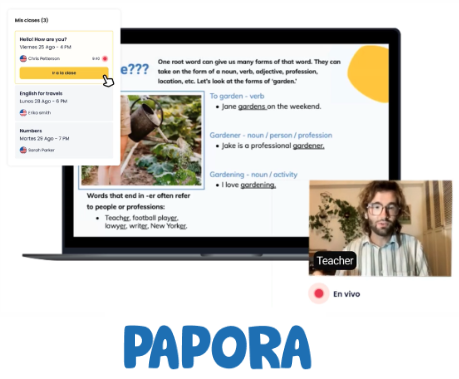


Benefits of English Training Programs
1. Close more deals with international clients
Trust is the most valuable currency in a negotiation. And that trust is built through clear, direct communication in the client's language.
A team that's fluent in English can reply to emails without delay, join sales calls without relying on an intermediary and present proposals without losing nuance in translation. The result is shorter sales cycles and stronger relationships with international partners.
For companies looking to enter the US, European or Asian markets, an English-proficient team is the difference between being taken seriously and being treated as a second choice.
2. Boost productivity on internationally focused teams
Misunderstood emails, meetings that drag on because nothing is clear, misread technical instructions in English: all of it costs time and money.
When employees are comfortable in English, they can go straight to technical documentation, manuals, SaaS platforms, tutorials and global resources, most of which are in English. This broadens their perspective, speeds up their professional growth and reduces dependence on translations or intermediaries.
That opens the door to more efficient ways of working and to global talent without borders.
3. Build confidence in meetings and negotiations
There's a huge difference between knowing English and being able to use it under pressure. In a meeting with a foreign client, an investor pitch or a contract negotiation, confidence is everything.
English for executives is designed for exactly that: training team leaders to present ideas clearly, argue their position and close deals without hesitating. An executive who's fluent in business English doesn't just represent the company better. They also project authority and credibility in every interaction.
4. Open new markets and business opportunities
One of the most common barriers keeping small and midsize companies from exporting their products or services is language. Hiring an intermediary or translator costs money, adds a layer of complexity and often dilutes the message the company wants to get across.
With an English-proficient team, that barrier disappears. The same people who serve the local market today can start managing clients in the United States, Canada, the United Kingdom or any English-speaking market, with no extra friction.
For startups and growing companies, this opens a window for expansion that once seemed out of reach. English turns a local team into a team with global reach.
5. Reduce turnover and improve talent retention
Talent isn't just looking for a paycheck. People want growth, learning and a future. According to LinkedIn, 94% of employees would stay longer at a company that invests in their professional development.
A well-designed English program sends a clear signal that the company is committed to developing its team. And not just any program: one that's ongoing, practical and useful in employees' real lives and careers.
When employees see the company investing in their training, their sense of belonging grows and turnover drops.
How many meetings, emails or negotiations are you losing to weak English?
Papora trains your team in real English applied to work: client conversations, presentations and international meetings. English that sells and gets results.
Create a free account
6. Strengthen company culture and inclusion
Companies that grow internationally face a specific challenge: bringing together teams across cultures, time zones and languages. English acts as the common language that unites those teams, removes internal barriers and makes cross-team communication easier.
When every employee has access to the same English training program, regardless of department or seniority, it sends a powerful message of inclusion: professional growth is for everyone.
Linguistic diversity is a strategic asset.
7. Improve your company's image with global clients
First impressions matter. And in international business, that first impression often happens in English: a video call, a sales proposal or a presentation at an international event.
A team with strong English projects professionalism and credibility, and attracts investors and partners. It's not just about speaking the language. It's about communicating well, using the right vocabulary for each context and showing that the company operates to international standards.
8. Spot global trends before your competitors
Most of the world's specialized knowledge is published in English first. Industry reports, market research, new methodologies, digital tools and shifts in international markets reach the Spanish-speaking world months later.
A team that's fluent in English doesn't wait for the translation. It reads the report the day it comes out, spots the opportunity before it hits the local radar and makes decisions with first-hand information. In competitive markets, that's worth more than any tactical advantage.
Why Your Company Needs Papora
English for real life and work, with no expiration date
Most corporate English programs have a structural problem: they end. A six-month course, however good, doesn't build the habit or the level a company needs to operate internationally. Languages are learned through continuous exposure, constant practice and up-to-date content.
Papora for Business works differently:
It has no end date. Employees keep learning with new lessons and practice, live classes with specialized instructors and a self-guided course that's constantly updated. It's not a sprint. It's a habit that grows with your team.
It's not a six-month crash course. It's a live, ongoing service that brings English into real life and the specific context of work: meetings, negotiations, presentations, emails and calls. The English employees learn on Papora is the English they'll use at the office tomorrow.
500+ self-guided lessons up to C1. Employees progress at their own pace with a structured curriculum that takes them from the fundamentals to advanced business English, the level demanded by the most competitive companies and international markets.
Pricing from $19 USD per employee per month, with full access to all courses and from 4 live classes a month.

The goal is clear: any company, whatever its size, should be able to build a team ready to grow internationally.
Every month without a structured English program is a month in which competitors move ahead, markets close and talent looks for companies that do invest in their growth. With Papora, the investment is affordable, the learning is continuous and the results are measurable.
Ready to take the next step? Explore different ways to improve English at your company and start making changes this week.
Before you invest, find out your team's real English level with Papora.
The first step is free: create an account and estimate your employees' English level in minutes. Get useful data from day one.
Create a free account
Frequently Asked Questions About the Benefits of English for Companies
There are options from $19 USD per employee per month, like Papora, which include full access to courses, live classes and self-guided content up to C1. It's an affordable choice even for small or growing companies.
English is the language of business. Speaking English lets employees communicate with international clients, take part in negotiations, access up-to-date technical information and come across with more confidence in global work environments.